Need to digitize your class notes? Sure, you can just snap a picture by-hand with your smartphone, but that always creates problems with shadows, roll, and yaw. Solution: Build A Smartphone Scanner To Digitize Your Notes
How about a microscope? Foldscope is a great initiative, but their initial 10K Microscope beta-trial is now closed. They are working on a commercial version, but in the meantime your only option is the follow the instructions in Foldscope: Origami-Based Paper Microscope (Cybulski et al., 2014, PLOS One). Or, try this $10 Smartphone to digital microscope conversion!
Of course, why not go the other way and Build Your Own Smartphone - the TyPhone:
Saturday, March 19, 2016
Tuesday, March 8, 2016
Does Technology Reduce the Cost of Teaching?
Corinne Ruff has a nice article in The Chronicle of Higher Education titled Does Technology Ever Reduce the Costs of Teaching? and the answer is, as expected, whatever you want it to be to support your agenda.
One thing seems clear, however: using open-source content, open textbooks, and open-source platforms does save real money, especially for the student.
For more on the business side of ed-tech consider The Business of Ed-Tech (2015), Bundling Textbook Costs with Tuition, or this interview with Audrey Watters.
One thing seems clear, however: using open-source content, open textbooks, and open-source platforms does save real money, especially for the student.
For more on the business side of ed-tech consider The Business of Ed-Tech (2015), Bundling Textbook Costs with Tuition, or this interview with Audrey Watters.
| http://www.socialhacks.com/education/the-skinny-on-buying-cheap-textbooks |
Thursday, February 25, 2016
Wearables in Education
Wearable technology - if you believe it - is the next big thing so Bower and Sturman (2015) looked at educator’s perceptions of how such technologies could be used in teaching and learning, specifically augmented or virtual reality devices such as Google Cardboard, Google Glass, Oculus Rift, Zeiss Cinemizer OLED 3D, or Samsung Gear VR. They summarize 14 potential uses and 10 potential concerns in their Table 1 and introduce the main issue on page 345:
Wearable technologies raise the question of whether people can adequately multi-task in order to utilize wearable devices safely and effectively.
Exactly: TMI! I’m convinced that most people simply cannot multi-task ‘fast’ enough to keep-up with the richness of the information (try The Invisible Gorilla if you disagree). Still interested? Explore Augmented and Virtual Reality in the Classroom by Kathy Schrock.
Still, wearables are definitely cool!
Loop from Stefan Wagner on Vimeo.
Wearable technologies raise the question of whether people can adequately multi-task in order to utilize wearable devices safely and effectively.
| http://www.bhphotovideo.com/explora/video/hands-review/using-zeiss-cinemizer-oled-3d-glasses |
Still, wearables are definitely cool!
- Try, for example, The Garden by H. Bosch in VR.
- Or Loop where you can reprogram your Oculus Rift Virtual World as you are experiencing it in 'real' time - The Matrix anyone? Read more about it over on Co.DESIGN.
- Or, PsychicVR by MIT.
Loop from Stefan Wagner on Vimeo.
Saturday, February 13, 2016
The Garden as a Story Map and in Virtual Reality
The Garden of Earthly Delights by Hieronymus Bosch features prominently in the The Bonobo and the Atheist by Frans de Waal. Of course, to see it you need to visit the Museo del Prado in Madrid, so here are a couple of less expensive options:
Bosch VR app trailer from BDH on Vimeo.
- You can experience The Garden in Virtual Reality if a) you own Google Cardboard and b) download the free Bosch VR app.
- Or, download the Bosch Non-VR app for your iPad.
- Jheronimus Bosch, the Garden of Earthly Delights is an interactive and narrated documentary or Story Map.
- Or, keep it simple with this one: The Garden of Earthly Delights.
Tuesday, February 9, 2016
The Quantified Student
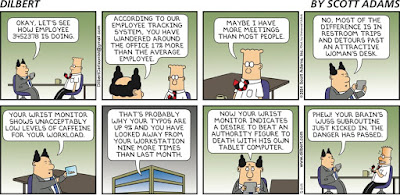
Adam Markowitz and Ryan Craig have proclaimed 2016 as the Year Of The Quantified Student. For context, Markowitz is the Founder and CEO of Portfolium and Craig a Managing Director at University Ventures. Here are two quotes:
Quantified Students will be able to map current skillsets against the requirements of target careers, evaluate the gap, and then select the educational program or path that gets them to their destination quickly and cost effectively.
As Quantified Students declare majors and continue to accrue skills, four years of academic work will find a permanent home in the cloud rather than in the trash. All of the underlying data will be indexed and eventually cashed in by students to prove competencies to skills-hungry employers.
Not surprisingly, Markowitz and Craig propose/promote e-portfolios for that 'permanent' home in the cloud - in some ways a logical extension of Claim Your Domain! and adaptive-learning tools like Knewton.
Of course, why would a Quantified Student spend 4-year on the campus of a small public college as opposed to filling the skill gaps identified by Big Data on the vast international private market of higher education? For a more nuanced discussion, consider From the Quantified Student to the Quantified Self by Audrey Watters.
Quantified Students will be able to map current skillsets against the requirements of target careers, evaluate the gap, and then select the educational program or path that gets them to their destination quickly and cost effectively.
As Quantified Students declare majors and continue to accrue skills, four years of academic work will find a permanent home in the cloud rather than in the trash. All of the underlying data will be indexed and eventually cashed in by students to prove competencies to skills-hungry employers.
Not surprisingly, Markowitz and Craig propose/promote e-portfolios for that 'permanent' home in the cloud - in some ways a logical extension of Claim Your Domain! and adaptive-learning tools like Knewton.
Of course, why would a Quantified Student spend 4-year on the campus of a small public college as opposed to filling the skill gaps identified by Big Data on the vast international private market of higher education? For a more nuanced discussion, consider From the Quantified Student to the Quantified Self by Audrey Watters.
![]() |
| http://dilbert.com/strip/2014-05-11 |
Saturday, January 30, 2016
My Prezi Is Better Than Your PowerPoint!
Prezi - and other 'infinite' non-linear digital presentation tools (e.g. SpicyNodes) - are alternatives to linear (aka boring) digital presentation tools such as Microsoft PowerPoint or Google Slides. Chou et al. (2015) went out to test the effects of different digital presentation tools on student learning and here is the key sentence (page 81):
However, compared to PowerPoint instruction, innovative features such as nonlinear presentation emphasized in Prezi showed no significant learning advantages.
My personal experience with Prezi is very limited - but those I have seen at workshops and conferences followed a more-or-less simple linear sequence and so I fail to see the advantage of one vs. the other.
However, compared to PowerPoint instruction, innovative features such as nonlinear presentation emphasized in Prezi showed no significant learning advantages.
My personal experience with Prezi is very limited - but those I have seen at workshops and conferences followed a more-or-less simple linear sequence and so I fail to see the advantage of one vs. the other.
![]() |
| https://www.linkedin.com/pulse/prezi-vs-powerpoint-establishing-objectives-tony-lazzari |
Saturday, January 2, 2016
What Do You Think About Online Education?
And - how does that compare to what the/your administration thinks?
For answers, consider the 2014 Survey of Online Learning Grade Level: Tracking Online Education in the United States, 2014 or 3 Things Academic Leaders Believe About Online Education on Wired Campus (the 71 comments are quite interesting!).
Here's the summary - academic leaders (tend to) think that:
For answers, consider the 2014 Survey of Online Learning Grade Level: Tracking Online Education in the United States, 2014 or 3 Things Academic Leaders Believe About Online Education on Wired Campus (the 71 comments are quite interesting!).
Here's the summary - academic leaders (tend to) think that:
- online education is critical for the success of the institution.
- hybrid courses are at least as good as f-2-f courses.
- the majority of their faculty don't think online courses are 'legit'.
Personally I always wondered how you can conduct 'classroom' observations needed for the tenure/promotion process in an online course.
Subscribe to:
Posts (Atom)


